In the Future, Will AI Determine What You Want and Need?
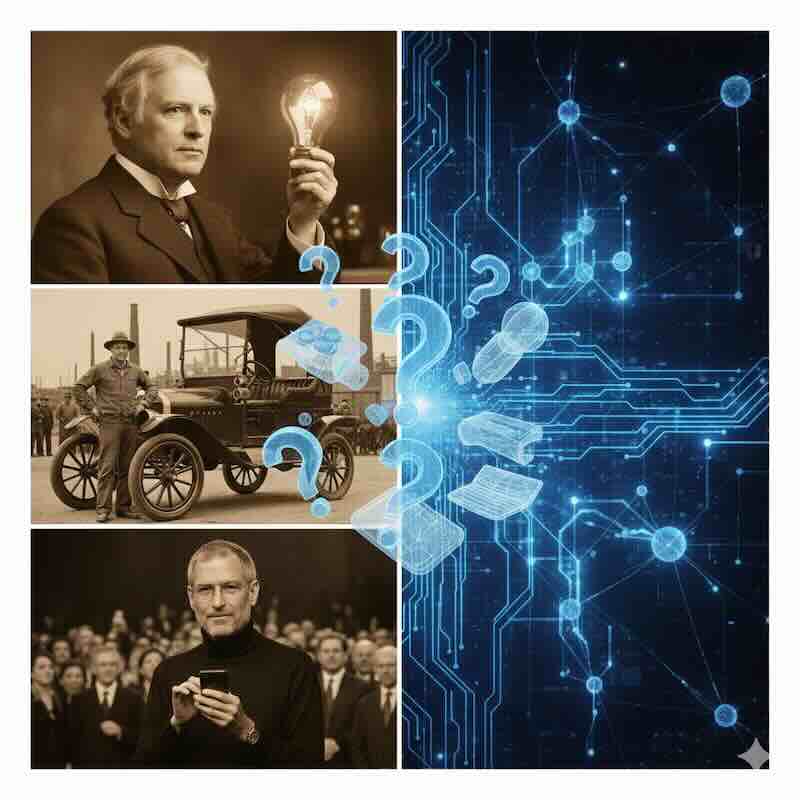
The Inventors Who Saw What We Couldn't
Thomas Edison, Henry Ford, and Steve Jobs shared one thing in common. They were skilled at identifying needs and fulfilling them. Edison lit up our world. Ford got us from point A to point B. Jobs understood human psychology, creating products we didn't even realize we needed.
Throughout history, the development of new products has been the purview of human beings who noticed something lacking, and hatched an idea for a product or service that would meet that need. But with so many of humanity's needs met, what's left to invent? Could it be that human imagination is reaching its limits in finding new ways to innovate? If so, is it possible that AI might be brought in to "deep think" for the next great ideas?
The End of Easy Innovation?
Let's be honest: we've picked a lot of the low-hanging fruit. The wheel? Invented. Indoor plumbing? Check. Smartphones that let us order tacos while watching cat videos? Done and done. The really obvious human needs—warmth, shelter, communication, transportation, entertainment—have been addressed in countless iterations. Sure, we keep refining these solutions (your phone is faster than last year's model, your car has more cup holders), but are we really inventing anymore, or just incrementally improving?
This is where things get interesting. And maybe a little unsettling.
Some futurists argue that human creativity might be bumping up against its biological ceiling. We evolved to solve immediate, tangible problems: find food, avoid predators, build better shelters. Our brains are incredible pattern-recognition machines, but they're optimized for the challenges our ancestors faced on the African savanna, not for dreaming up the next paradigm-shifting technology. When Steve Jobs introduced the iPhone, it wasn't because consumers were clamoring for a touch-screen computer in their pocket—most people couldn't even articulate that need. Jobs saw around corners that the rest of us couldn't.
But what happens when there are no more corners to see around? Or when the corners are so abstract, so removed from our lived experience, that human intuition can't reach them?
Enter the Machine Oracle
Here's where AI enters the chat, metaphorically rolling up its digital sleeves. Modern AI systems can process vastly more data than any human brain—analyzing patterns across millions of consumer behaviors, scientific papers, market trends, and social media posts simultaneously. They can spot correlations we'd never notice, identify gaps in markets we didn't know existed, and theoretically predict needs before we even feel them.
Companies are already using AI for product development in fascinating ways. Algorithms analyze customer reviews to identify pain points in existing products. Machine learning models predict which features consumers will want based on demographic data and purchasing patterns. Some AI systems even generate entirely new product concepts by recombining existing ideas in novel ways, like a digital Edison tinkering in an infinite workshop.
IBM's Watson, for instance, has been used to create new recipes by analyzing flavor compounds and cultural food preferences—coming up with combinations no human chef would have considered. Pharmaceutical companies use AI to identify potential drug candidates from billions of molecular combinations. Fashion brands employ algorithms to predict next season's trends before human designers have even picked up their sketchbooks.
The question isn't whether AI can innovate—it's already doing it. The question is whether it can do what Edison, Ford, and Jobs did: identify needs we don't even know we have yet.
The Empathy Problem
But here's the rub: those legendary innovators didn't just solve problems—they understood human experience. Jobs didn't create the iPhone because data suggested people needed internet in their pockets. He created it because he intuitively grasped how technology could become an extension of human desire, identity, and connection. He felt it in his gut.
Can AI have a gut feeling? Can it understand the subtle frustration of fumbling with too many devices? The joy of discovering something unexpectedly delightful? The anxiety of feeling disconnected in a crowded room? These emotional undercurrents drive so much of human need, yet they're precisely the things machines struggle to grasp.
AI can tell you that people who buy running shoes also tend to buy fitness trackers. But can it understand the deeper human yearning for self-improvement, the fear of mortality that drives us to exercise, or the social validation we seek from posting our workout stats? These layers of human psychology are the fertile soil from which truly transformative innovations grow.
There's also the question of creativity versus optimization. AI excels at finding efficient solutions to defined problems. But genuine innovation often comes from rebellious, illogical thinking—from someone saying, "What if we did something totally impractical and weird?" Jobs famously studied calligraphy, which seemed utterly useless for computer science until it influenced the beautiful typography of the Mac. Would an AI ever take a calligraphy class? Would it see the value in what appears to be a complete tangent?
A Partnership, Not a Replacement?
Perhaps the future isn't about AI replacing human innovators—it's about collaboration. Imagine a hybrid approach where AI serves as a tireless research assistant and pattern-finder, surfacing insights from data oceans too vast for humans to navigate, while human innovators provide the intuition, empathy, and creative leaps that machines can't replicate.
AI might identify that consumers in urban areas are experiencing increasing anxiety about something (let's say, package theft), and that current solutions are 73% ineffective. But the human innovator brings the creative spark that transforms that data point into an elegant solution—maybe a neighborhood-sharing app, or a new type of secure lockbox, or something we can't even imagine yet because it requires that uniquely human ability to think sideways.
Some companies are already exploring this model. Design firms use AI to generate hundreds of initial concept variations, which human designers then refine based on aesthetic sensibility and emotional resonance. Drug researchers let AI narrow down millions of compounds to a promising few hundred, which human scientists then test with an understanding of how real patients will respond to treatments.
The Darker Possibilities
Of course, we'd be naive not to consider the potential downsides. If AI becomes too good at predicting what we want, do we risk creating a feedback loop where innovation becomes purely reactive, giving us only incremental improvements on existing desires rather than truly transformative ideas? Do we end up in a world of "more of the same, but optimized"?
There's also the concern about manipulation. An AI that can predict what you need could easily blur the line between fulfilling genuine needs and creating artificial ones. If an algorithm determines that showing you a certain product at a certain emotional moment will trigger a purchase, is that meeting a need or manufacturing desire? The difference matters, ethically speaking.
And let's talk about job displacement. If AI can handle the "noticing needs" part of innovation—traditionally a uniquely human skill—what happens to all those product managers, designers, and entrepreneurs whose entire career is built on that ability? We might need to invent new roles for humans in the innovation process, which is ironically itself an innovation challenge.
There's also something vaguely dystopian about the idea of machines telling us what we need. It feels like surrendering a fundamental aspect of human agency. Part of the human experience is discovering our own needs, making mistakes, wanting things that turn out to be not-quite-right, and learning from that process. If AI shortcuts all of that, do we lose something essential about self-discovery and growth?
The Verdict: Augmented Innovation
So will AI determine what we want and need in the future? The answer is probably "sort of, but not entirely." AI will likely become an increasingly important tool in the innovation process—identifying patterns, predicting trends, and generating concepts at a scale impossible for humans alone. Companies that ignore this capability will probably fall behind.
But the uniquely human elements of innovation—empathy, intuition, creative rebellion, and the ability to imagine solutions to problems we can't quite articulate—aren't going away. At least not yet. The most exciting future might be one where AI handles the "what" (what patterns exist, what gaps are in the market, what combinations are possible) while humans provide the "why" (why this matters, why people will care, why this solution is meaningful).
Think of it less like AI replacing Edison, Ford, and Jobs, and more like giving them a superpower—the ability to see patterns across all of human behavior and culture simultaneously, while still maintaining that spark of human insight that turns data into magic.
The real innovation challenge might not be teaching AI to dream up our future needs—it might be figuring out how humans and AI can collaborate in ways that combine the best of both: the machine's computational power and the human's emotional intelligence. Because at the end of the day, the best innovations aren't just clever solutions to problems. They're expressions of human values, desires, and dreams.
And hopefully, we'll always want to keep those in human hands. Even if those hands are being guided by some very smart algorithms.