The Wrist Helper That Wasn't: When Will Apple Watch Finally Let Us Talk to AI?
The Promise That Wasn't There
Picture this: You're excited about AI. You've been having fascinating conversations with Pi AI—learning new things, exploring ideas, working through problems—all through natural voice conversation. The experience is so good that you start thinking, "wouldn't it be amazing if I could just raise my wrist and continue these conversations without pulling out my phone?" So you ask Pi if there's an Apple Watch app that would let you do exactly that. Pi confidently tells you yes, absolutely, that capability exists. You get excited. You spend several hundred dollars on an Apple Watch. And then you discover the truth: Pi lied to you.
Well, not intentionally. Pi didn't maliciously deceive anyone. It just did what AI systems often do when they don't actually know something—it confidently made something up that sounded plausible. This is the hallucination problem in action, and it cost me an Apple Watch purchase based on a feature that didn't exist. Pi apologized with a casual "my bad," which felt a little inadequate given the circumstances, but what are you going to do? Artificial intelligence doesn't have a returns department.
So I had the watch, but not the capability I'd bought it for. And it turns out I wasn't alone in wanting this. The dream of having a genuinely smart AI assistant available at a glance, accessible through nothing more than raising your wrist and speaking naturally—that's something a lot of Apple Watch owners have been craving. The question is: when will we actually get it?
The Workaround Wasteland
To be clear, there are some Apple Watch AI apps available. Apps like Petey allow you to interact with ChatGPT from your Apple Watch, using dictation to ask questions and having the AI read responses back to you. There are others too—WatchMyAI, AI Watch Assistant, and various implementations that technically let you access AI from your wrist. But here's the problem: none of them deliver the organic, conversational experience that makes AI assistants feel useful rather than clunky.
Most of these solutions rely heavily on dictation for input, which means you're essentially typing with your voice. Then you wait. Then the AI responds, and you either read it on a tiny screen or have it read back to you. Then you dictate again if you want to follow up. It works, technically, but it's not a conversation—it's a series of disconnected exchanges that feel more like sending telegrams than talking to an intelligent assistant.
The apps that exist feel like workarounds rather than solutions. They're built on top of APIs and systems that weren't really designed for the wrist-based, glance-and-go experience that would make them genuinely useful. You can get answers, but the friction is high enough that most people end up just pulling out their phones anyway, which defeats the entire purpose of having the capability on your watch in the first place.
Why Is This So Hard?
The Apple Watch has a microphone. It has speakers. It has internet connectivity. In theory, enabling natural AI conversations should be straightforward. So why isn't it? The answer involves technical limitations, business decisions, and the fact that Apple's own AI assistant has been embarrassingly behind the competition for years.
Siri on Apple Watch can set timers, start workouts, and send messages, but ask it to have an actual intelligent conversation and you'll quickly hit its limits. It can't maintain context across multiple exchanges. It struggles with anything beyond basic commands. And it certainly can't match the conversational fluency of ChatGPT, Claude, or Pi. For years, Apple Watch owners have had a microphone, speakers, and connectivity to potentially amazing AI—but they've been stuck with Siri, which is like having a Ferrari with a lawnmower engine.
Third-party developers face their own challenges. Creating a truly conversational AI experience requires low latency, sophisticated audio processing, natural language understanding, and seamless context management. On a device with limited processing power, small screen, and battery constraints, delivering all of that smoothly is genuinely difficult. The apps that exist have made valiant efforts, but they're working within significant technical constraints.
The 2026 Promise (Maybe)
There's good news on the horizon, assuming Apple can actually deliver on its promises this time. Apple has set an internal release target of spring 2026 for a major Siri upgrade that would enable more conversational, context-aware interactions. This isn't minor tweaking—it's a complete architectural overhaul that would finally bring Siri into the modern AI era.
The upgraded Siri is being built using large language models similar to ChatGPT, with the project codenamed "Veritas" designed to give Siri more natural, conversational intelligence. This would theoretically enable the kind of back-and-forth dialogue that makes AI assistants genuinely useful. For Apple Watch specifically, the improvements would include more natural and context-aware interactions with Siri, allowing for complex queries and personalized responses.
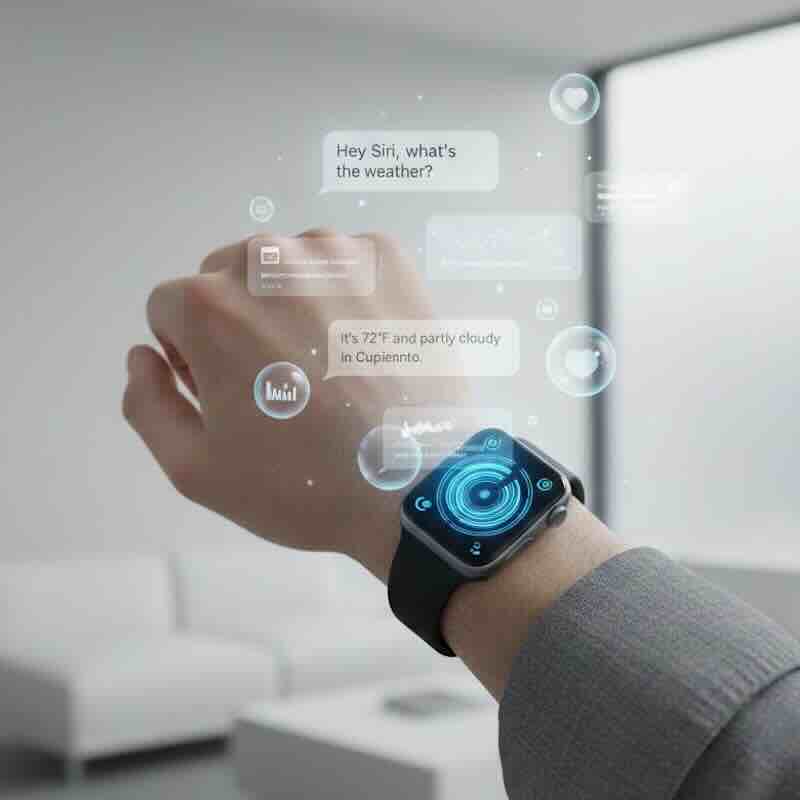
Imagine being able to raise your wrist and say "Hey Siri, I'm thinking about taking up woodworking as a hobby, what should I know before I start?" and having it respond with thoughtful advice, then being able to naturally follow up with "What tools would I need to get started?" and "Are there safety concerns I should worry about?" without having to re-explain the context each time. That's the vision. Whether Apple can actually deliver it remains to be seen.
The Delay Problem
Here's the frustrating part: we were supposed to have some of this already. Apple originally expected Siri's advanced features to be released in spring 2025, but announced in March 2025 that these features were being delayed until 2026. The company admitted it's taking longer than expected to deliver on these promises.
This delay has consequences beyond disappointed users. The pressure has heightened since the arrival of OpenAI's ChatGPT in late 2022 ushered in the era of generative AI, with Apple risking falling behind rivals including OpenAI, Amazon, and Google. Every month that Apple Watch owners can't have natural AI conversations from their wrist is another month where the gap between the promise of wearable technology and its actual capability remains frustratingly wide.
The technical challenges are real. Apple found that the limitations of the original Siri architecture weren't getting them to the quality level customers needed, forcing a switch to a deeper end-to-end architecture. In other words, they tried to patch the old system and realized they needed to essentially rebuild it from scratch. That's why we're looking at spring 2026 for the full rollout—assuming there are no further delays.
The Temporary Google Solution
In a move that feels both pragmatic and slightly desperate, Apple is partnering with Google to bridge the gap. The company is paying Google approximately $1 billion per year for access to Gemini AI to power parts of Siri's backend. This is the same story I covered in another article about Siri's overhaul, but it's worth mentioning here because it directly affects when Apple Watch owners might finally get their conversational AI.
The Google-powered improvements should arrive with the 2026 rollout, assuming everything goes according to plan. But Apple doesn't intend this to be permanent—they're working on their own competitive AI model to eventually replace the Google partnership. So Apple Watch owners are essentially waiting for Apple to catch up to where Google already is, using Google's technology as a temporary crutch, with the hope that Apple's own solution will eventually be ready.
It's a weird situation. Your wrist already has all the hardware needed for amazing AI conversations. The technology exists—you can access ChatGPT, Claude, or Pi on your phone right now and have those exact conversations. But the integration, the seamlessness, the "raise your wrist and just talk naturally" experience? That's still somewhere in the future, locked behind software updates and corporate strategies and technical challenges.
What Works Right Now (Sort Of)
If you can't wait until 2026 and you're determined to have AI conversations from your Apple Watch right now, your best bet is probably one of the third-party apps like Petey or WatchMyAI. They're not perfect, but they do technically work. You can ask questions, get answers, and have basic back-and-forth exchanges. Just set your expectations appropriately—you're not going to get the fluid, natural conversation experience you'd have on your phone.
Some users have found workarounds involving Shortcuts, Siri's ChatGPT integration, and creative uses of the dictation features. These solutions exist in a gray area of "technically functional but kind of awkward." They're better than nothing, but they're not the elegant solution that Apple is supposedly building toward.
The other option is to be patient and wait for the official Apple solution. If spring 2026 actually brings the promised Siri improvements to Apple Watch, it could finally deliver the experience that many of us thought we were buying when we got the watch in the first place. The catch is that "spring 2026" is Apple's current timeline, and we've already seen one major delay. There's no guarantee the next deadline will stick either.
Why This Matters More Than You Think
This might seem like a relatively minor feature request—the ability to chat with AI from your wrist instead of your phone. But it actually represents something bigger about the future of wearable technology. The Apple Watch is supposed to be about reducing friction, about quick glances and simple interactions that don't require pulling out your phone. An AI assistant you can actually converse with naturally would be a killer application for that vision.
Think about the contexts where wrist-based AI would be genuinely useful. You're cooking and need to convert measurements—raise your wrist, ask, get an answer, keep cooking. You're driving and want to think through a problem—talk it out with your watch without taking your eyes off the road. You're on a walk and want to learn about something—have the conversation happen naturally as you walk. The phone stays in your pocket. The interaction is seamless. That's the promise.
But that promise requires more than just access to AI—it requires the interaction to be smooth enough that it doesn't create more friction than it eliminates. Having to carefully dictate, wait for processing, read a small screen, and then repeat the process isn't that. What we need is genuine conversational AI that works at the speed of thought, or at least at the speed of natural speech. We're not there yet.
The Lesson (Beyond "Don't Trust AI About AI Apps")
My Pi-induced Apple Watch purchase taught me something beyond "verify things AI tells you before spending money": we're living in a weird transitional period where the technology exists but the implementation doesn't. The AI models that could power amazing wrist-based conversations are real and working. The hardware to support them is in millions of Apple Watches already sold. What's missing is the software integration, the business decisions, and the prioritization to make it happen.
Apple has the resources, the hardware install base, and (eventually) the AI capability to deliver this experience. They're just taking their time getting there, whether due to technical challenges, strategic decisions, or the sheer difficulty of rebuilding Siri from the ground up. In the meantime, Apple Watch owners are left with a device that feels like it should be able to do more than it actually can.
I'll keep using my Apple Watch for what it does well—fitness tracking, notifications, timers, "time to take your pill" alerts, and oh yes, telling me what time it is—while occasionally glancing at my wrist and imagining the conversations I could be having if Pi hadn't been so confidently wrong. Maybe by spring 2026, I'll finally get the feature I thought I was buying in the first place. Until then, my iPhone stays in my pocket, ready to be pulled out whenever I want to actually talk to an AI that can hold a real conversation.
Here's hoping the wait is worth it. And here's hoping that when Siri 2.0 finally arrives on Apple Watch, it doesn't respond to complex questions with "Here's what I found on the web." Because at that point, we'll all know that even the upgraded Siri is still just a lawnmower engine pretending to be a Ferrari.