Extreme Ultra-Violet (EUV) Lithography: How the Light Fantastic is Making Your Chips Tiny
The Secret Sauce: Seriously Short Light
Remember when your phone felt like a brick, and your computer took ten minutes to boot up? We all have Moore's Law—that decades-old prediction about transistor density doubling regularly—to thank for the sleek, lightning-fast gadgets in our pockets today. But around the early 2010s, things got dicey. Our traditional light-based methods for carving circuits were hitting a wall. Enter the hero of this story, the superhero of scaling: Extreme Ultra-Violet (EUV) Lithography.
This technology is an absolute game-changer, essentially a microscopic, high-tech stamp that lets us etch patterns on silicon wafers smaller than anything we’ve done before. Without it, your new AI-powered super-phone might still be a figment of a scientist's imagination.
Lithography is just a fancy word for "printing" circuits onto a silicon wafer using light. The smaller the wavelength of light you use, the finer the details you can print. Previous methods, like Deep Ultra-Violet (DUV) lithography, used light with a wavelength of 193 nanometers (nm). EUV slashes that down to a crazy tiny 13.5 nm. To put that in perspective, that's almost 15 times smaller! This allows manufacturers to print features on chips that are below 7 nm, which is how we get billions of transistors packed onto a single chip.
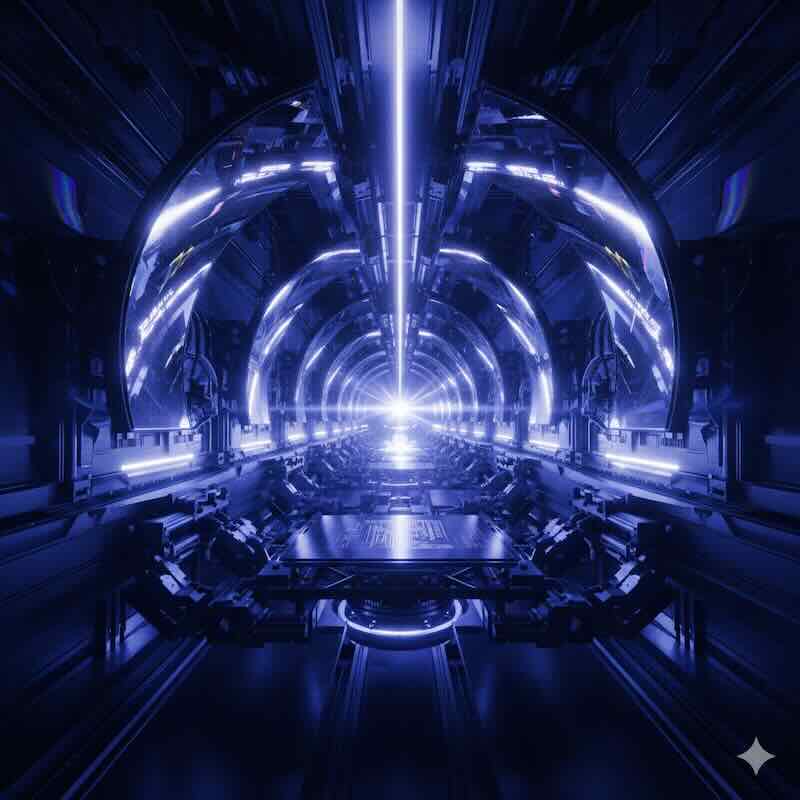
The process itself is a complex ballet of physics and engineering. You can’t just shine 13.5 nm light through a glass lens—it gets absorbed instantly, even by air! That's why the entire process happens in an ultra-high vacuum and uses an ingenious system of reflective mirrors instead of lenses. Fun fact: To generate the 13.5 nm EUV light, a powerful CO2 laser fires two pulses at a micro-droplet of molten tin—50,000 times per second! It's a tiny, perfectly controlled explosion happening continuously inside the machine.
What This Means for You (Beyond the Tech Jargon)
EUV lithography isn't just a win for physics nerds; it’s a massive leap forward for every gadget you use. Its biggest impact is simply letting us keep shrinking things down, which results in:
- Faster Performance: More transistors mean more computing power packed into the same space. Hello, instant apps and flawless 4K streaming!
- Better Energy Efficiency: Smaller transistors require less power to switch on and off. This translates directly to phones with longer battery life and powerful data centers that are less power-hungry.
- AI and the Future: The intense computational needs of Artificial Intelligence, from self-driving cars to complex medical diagnostics, demand chips made with this level of density. EUV is the backbone supporting the AI revolution.
The Flip Side: Challenges and Pitfalls
While the future looks bright, getting EUV to work has been a decades-long headache and it still presents some significant wrinkles. The machines themselves, built almost exclusively by the Dutch company ASML, are the size of a bus and cost hundreds of millions of dollars each. They are the most complex machines ever built, and their operation is incredibly demanding.
It’s easy to be dazzled by the raw power and complexity of EUV, but we need to keep a vigilant eye on its broader impact. This technology concentrates enormous chip-making power in the hands of a very small number of companies (both manufacturers and the one supplier of the machines). This centralization creates potential supply chain bottlenecks and geo-political risks. Moreover, these machines are absolute energy beasts, requiring immense amounts of power to run, which raises genuine sustainability concerns as the world races to build more chips. Innovation is awesome, but we need to responsibly manage its global consequences.
Ultimately, EUV lithography is the brilliant, complex, and unbelievably expensive technology that truly saved Moore's Law for this generation. It’s what's powering your digital world right now, and as the industry moves toward even more advanced "High NA" EUV systems, we're likely to see the digital universe shrink and speed up even more.