Precision Logging: Harvesting for a Smarter Future
Precision Logging: Harvesting for a Smarter Future
The sight of clear-cut forests has long been a stark reminder of humanity's impact, often conjuring images of environmental devastation. But what if forest harvesting could be a symphony of precision, guided by data, and even informed by the "health" of individual trees? Enter the new era of forestry, where technology is transforming logging from a blunt instrument into a finely tuned art, aiming for both resource provision and ecological stewardship.
The Technological Canopy
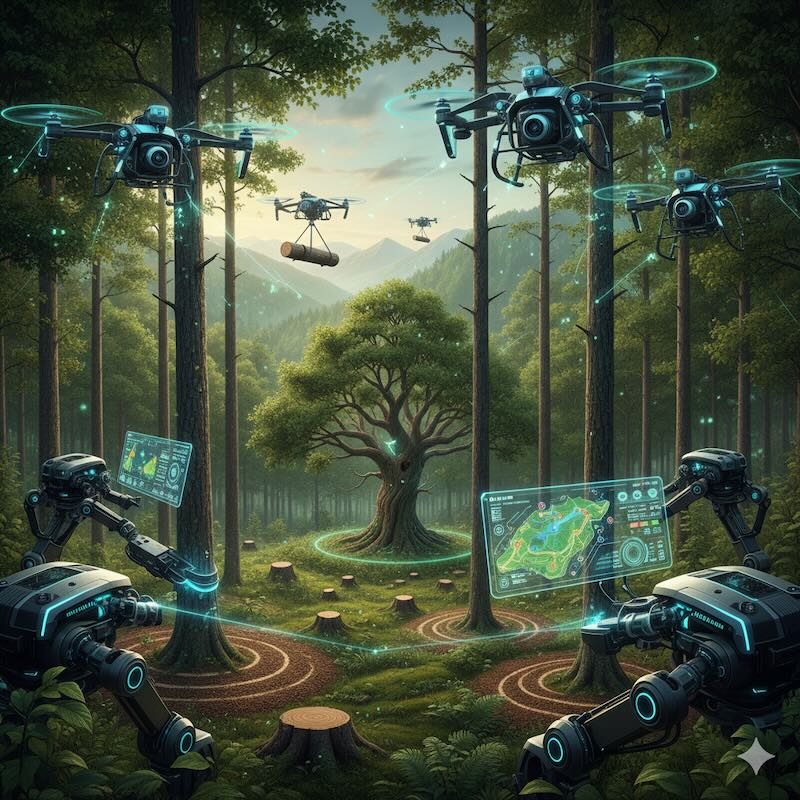
At the heart of these advancements are sophisticated sensor systems, AI-driven analytics, and robotic machinery. Drones equipped with LiDAR (Light Detection and Ranging) and hyperspectral cameras now map vast forest tracts in incredible detail. They don't just count trees; they measure individual tree health, species, age, growth rate, and even carbon sequestration potential. This data then feeds into AI algorithms that recommend optimal harvesting strategies.
We're talking about Precision Forestry. This isn't just about cutting down trees faster; it's about identifying which trees to cut, when, and how, to maximize forest health, biodiversity, and long-term yield. Imagine a "digital twin" of a forest, constantly updated with real-time data, allowing forest managers to make decisions with unprecedented accuracy. This leads to practices like "variable retention harvesting," where specific patches or individual trees are left to maintain ecological continuity and genetic diversity.
Robotic Arborists and the Light Footprint
The harvesting itself is also undergoing a revolution. Advanced feller bunchers and harvesters are becoming more autonomous, using GPS and AI to navigate difficult terrain and selectively cut trees with minimal impact on surrounding vegetation and soil. Their robotic arms can precisely limb and buck trees on site, reducing waste and leaving nutrients in the forest floor. There's even experimental tech for "cable logging" that uses aerial drones to transport logs from challenging terrain, avoiding the need for heavy machinery to churn up sensitive areas.
The potential benefits are astounding. Optimized resource use means less waste and more efficient timber production. Reduced soil disturbance helps maintain forest integrity and water quality. And by prioritizing forest health, these techniques can enhance carbon capture, making forests more resilient to climate change, fires, and pests. It truly offers a glimpse of a future where industrial activity and ecological respect can find a new, harmonious balance.
The Shadow in the Old Growth
As we are seeing, every powerful new technology casts a shadow. The sheer efficiency and data-driven nature of precision logging raise important questions. Could the drive for optimization inadvertently lead to monocultures of "ideal" timber trees, reducing genetic diversity in the long run? What are the implications for remote, indigenous communities who rely on traditional forestry practices and may be displaced or overlooked by hyper-efficient automated systems? And who controls this vast dataset of "sentient forests," guiding the decisions that will literally shape our landscapes for generations?
The promise of a smarter, more sustainable forestry future is undeniably exciting. But as we embrace these tools, we must ensure that the definition of "optimal" harvesting extends beyond economic yield to encompass true ecological health, social equity, and the preservation of the wild, untamed essence of our planet's invaluable forests. Only then can we ensure that precision logging serves not just our needs, but the needs of the entire forest ecosystem.