The Future of Art: When Algorithms Dream and Humans Question Creativity
The Revolution Nobody Saw Coming
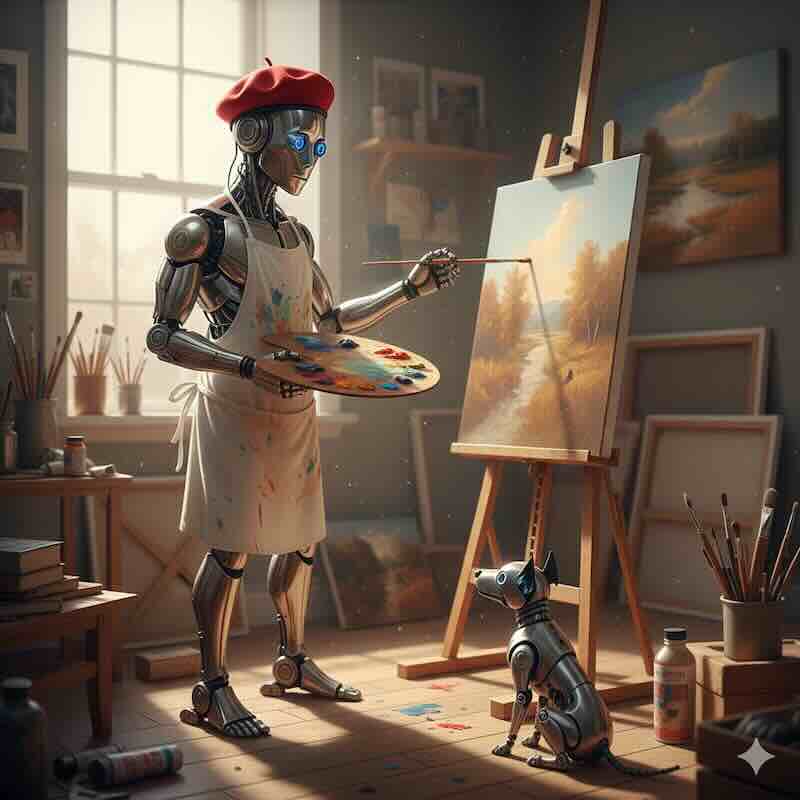
We have a love-hate relationship with AI, don't we? At the same time that we embrace it when it gets us to an end point faster (I described the illustration I wanted for this article, and Gemini drew it for me in seconds), the almost-too-convenient nature of it seems a little unnerving too, doesn't it?
Art was supposed to be the last bastion of human uniqueness. While we accepted that machines might eventually drive our cars and diagnose our illnesses, surely they couldn't paint, compose music, or write poetry—activities that require soul, emotion, lived experience. Right? Well, 2025 is here with some uncomfortable news: AI-generated art is projected to represent 5% of the total contemporary art market, with the global AI image generation market expected to reach $1.3 billion. AI isn't just making art—it's selling it, exhibiting it, and in some cases, making it better than many humans can.
The speed of this transformation is staggering. Tools like DALL-E, Midjourney, and Adobe Firefly can generate museum-quality images in seconds. Type "melancholic robot contemplating sunset in the style of Van Gogh" and watch as an algorithm produces something that looks like it took weeks to paint. The technology is accessible to anyone with internet access, democratizing art creation in unprecedented ways. But this raises profound questions: What happens to human artists? What is art when divorced from human experience? And will future generations even care about the difference?
The Media Explosion
Digital art is exploding across every medium imaginable. We're seeing AI-generated illustrations flooding commercial design, from logo creation to book covers to advertising campaigns. 62% of marketing professionals have already incorporated AI-generated visuals into their campaigns, and 45% of design agencies use AI tools to supplement their creative processes. Video AI tools like Runway and Sora enable animated narratives that would have required entire studios just a few years ago.
But it goes deeper than static images. Interactive AI art creates dynamic pieces that evolve based on viewer interaction, environmental conditions, or social media trends. Virtual reality galleries showcase AI-generated environments that respond to visitors' movements. Augmented reality overlays AI elements onto physical spaces, creating mixed-reality artistic experiences. We're moving toward art that isn't just viewed—it's experienced, and it changes based on who's experiencing it.
The most interesting development might be what's called "hyper-personalized style transfer"—AI that can analyze your preferences and generate art specifically tailored to your taste. Imagine walking into a virtual gallery where every piece adapts to your emotional state, artistic preferences, and viewing history. It's seductive. It's also potentially troubling in ways we're only beginning to understand.
The Human Divorce Question
Here's the uncomfortable part: art is becoming increasingly divorced from the human equation. When a Berlin-based multimedia artist says "I use AI to generate the starting point, and then my job is to destroy it, rework it, humanize it," that's collaboration. But what about the millions of AI-generated images that skip the humanization step entirely? What about the logos, illustrations, and designs that go straight from prompt to production with no human touch beyond the initial text input?
Nearly half of artists (48.3%) don't consider AI-generated art as a legitimate form of creativity, while others embrace it as just another tool. The divide is real and growing. Traditional artists spend years developing skills, learning to see light and shadow, understanding color theory, developing a personal style. AI skips all that. It analyzes millions of existing artworks, extracts patterns, and recombines them in novel ways. It's sophisticated pattern matching, not lived experience translated into visual form.
The question isn't whether AI can produce visually appealing images—clearly it can. The question is whether that matters. When we look at art, we're not just appreciating technical skill. We're connecting with another human consciousness, seeing the world through someone else's eyes, feeling their joy or pain or wonder. Can an algorithm that has never experienced anything create art that truly moves us? Or are we just being fooled by pretty pictures that push our aesthetic buttons without meaning anything?
Derivative or Creative?
One of the biggest criticisms of AI art is that it's fundamentally derivative. AI models learn by analyzing existing human-created art—millions of images, paintings, illustrations. They identify patterns, styles, techniques, and then recombine them. They can't create something genuinely new because they can only work with what they've been fed. It's remixing, not inventing.
But here's the counterargument: isn't all art derivative to some degree? Human artists learn by studying masters, copying techniques, absorbing influences. Picasso famously said "good artists copy, great artists steal." The difference is that human artists filter everything through their unique consciousness, their life experiences, their emotional reality. They're not just recombining patterns—they're expressing something about what it means to be human.
If we allow generative AI to destroy human creative industries by displacing jobs and discouraging aspiring artists, we're heading toward a future where art and music styles are fixed and static. New artistic movements historically emerge from human experience—hip-hop grew from the struggles of Black, Latino, and Caribbean youth in 1970s New York. Can AI create the next revolutionary art movement? Or can it only iterate on what already exists?
The Economic Reality
Let's talk money, because that's where the rubber meets the road. Christie's February 2025 "Augmented Intelligence" auction earned $728,784, with 48% of bidders coming from millennial and Gen Z collectors. AI art is selling. Companies are replacing illustrators, designers, and concept artists with AI tools that cost a fraction of human labor. Why pay an artist $5,000 for a series of illustrations when AI can generate hundreds of variations for the cost of a subscription?
This is creating real casualties. Freelance illustrators are seeing work dry up. Junior designers can't get their foot in the door because entry-level positions are being eliminated. The pathway from aspiring artist to professional is crumbling. And 60% of art collectors are concerned about the lack of emotional connection with AI-generated art due to the absence of human involvement, yet they're still buying it.
The cruel irony is that AI art tools were trained on the work of human artists—often without permission or compensation. Artists spent decades developing skills and creating portfolios, and now those same portfolios are being used to train systems that compete with them. It's like being forced to train your replacement, except you never agreed to it and you're not getting paid.
Will It Benefit Humanity?
This is the big philosophical question. On the optimistic side, AI art democratizes creativity. Someone who can't draw can now create visual art. Someone with a story to tell but no technical skills can generate illustrations for their book. Small businesses can afford custom artwork. Education is incorporating AI tools, preparing students for a future where digital fluency matters as much as traditional techniques.
Research argues that AI does not replace human creativity but rather augments it, offering novel ways to expand artistic boundaries and democratize creative expression. The best outcomes might come from human-AI collaboration—artists using AI to explore possibilities they'd never considered, then applying human judgment and emotion to refine the results. Think of it as a power tool for creativity rather than a replacement for the craftsperson.
But the pessimistic view is darker. If AI floods the market with cheap, derivative art optimized for mass appeal, do we lose the challenging, uncomfortable, boundary-pushing art that makes us grow? Art has historically been a mirror held up to society, showing us truths we'd rather not see. Can AI do that? Or will it just give us endless variations of what algorithms determine we already like?
There's also the cultural concern. Art is deeply connected to cultural identity, historical moment, personal struggle. If art becomes primarily AI-generated, divorced from human experience, do we lose something essential about how we process and communicate the human condition? Do we end up with technically proficient images that mean nothing?
The Path Forward
Parts of the creative process can be automated in interesting ways using AI, but the creative decision-making which results in artworks cannot be replicated by current AI technology. That's the key insight from researchers studying this phenomenon. Human agency in the creative process isn't going away—it's evolving.
The artists who will thrive are those who use AI thoughtfully while maintaining their unique human perspective. AI becomes the assistant, the collaborator, the tool that handles repetitive tasks and generates possibilities—but the human remains the curator, the decision-maker, the one who infuses meaning and intention into the work. It's similar to how photography didn't replace painting but became its own legitimate art form. Perhaps AI art will do the same.
But we need to protect human artists in this transition. That means addressing copyright issues around training data. It means ensuring that aspiring artists have pathways to develop their skills and build careers. It means audiences learning to value and seek out human-created art, understanding that the connection between creator and viewer is part of what makes art meaningful. It means companies thinking twice before replacing entire art departments with subscription software.
The Uncomfortable Truth
The future of art is probably a messy hybrid. AI-generated art isn't going away—the technology will only get better, the market will continue growing, and businesses will keep adopting it for practical reasons. But art that truly matters, art that challenges us and changes how we see the world, will likely remain human. At least, that's what I want to believe.
The real test isn't whether AI can make pretty pictures—it clearly can. The test is whether those pictures will mean anything fifty years from now. Will they be remembered, discussed, studied? Or will they be forgotten as quickly as they were generated, just more visual noise in an already oversaturated digital landscape?
Art has always reflected the human experience—our joys, sorrows, struggles, triumphs. As long as humans have experiences worth expressing and audiences hungry for genuine connection, there will be a place for human artists. But that place might be smaller, more specialized, and harder to reach than it used to be. And that's a loss we should all recognize, even as we marvel at what the algorithms can do.