Will Future Tech Break the Bank? From Winchester Drives to Billionaire Sandboxes
The Great Price Plunge
Technology is racing ahead a breakneck speed, and we're all scrambling to keep up with it. Will tech eventually become so advanced and so costly that it becomes the sole domain of millionaires and billionaires? Or will those who produce and market tech need to find ways to keep it affordable to the masses, as they have in the past?
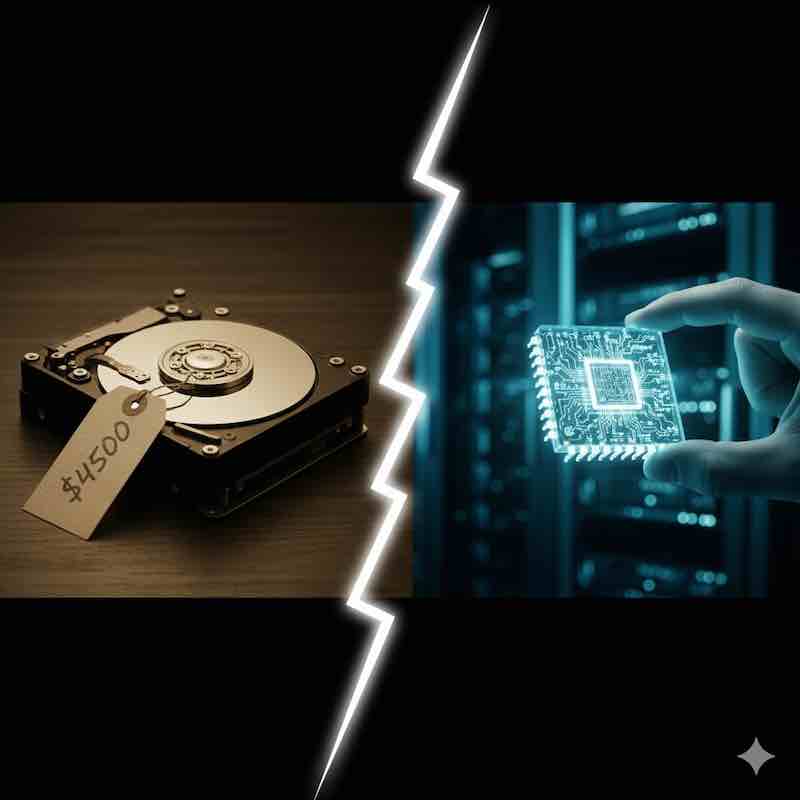
Historically, Tech Has Become More Affordable, Not Less. When they first came out, personal computers were very costly. As tech advanced since the introduction of personal computers, their prices have dropped precipitously, making them accessible to most of the general public. Now, for just a fraction of the cost of a 1980 PC, current computers are literally MILLIONS of times faster. Similarly, hard drive storage used to be something only the wealthy could afford. Ten megabytes of storage on a Winchester hard drive sold for about $4500. That's $450 per megabyte! Now, a megabyte of storage on a typical computer or device costs a tiny fraction of one penny.
The question is, how well does this trend of more-tech-for-less-money translate into the world of the future? Let's explore whether the even more advanced technology that's coming our way in the decades ahead will remain within reach of "every Tom, Dick, and Harry."
Moore’s Law vs. The Billionaire’s Playground
For decades, we’ve relied on **Moore’s Law**—the observation that the number of transistors on a microchip doubles roughly every two years while the cost of computers is halved. It’s the reason your smartphone has more computing power than NASA had when they put a man on the moon. If this trend continues for things like robotics or genetic editing, we’re in for a golden age of "High Tech" at "Low Touch" prices. But we have to be realistic. We are entering an era of "Deep Tech" where the initial buy-in isn't just a few thousand bucks—it's billions. When we talk about life extension, private space travel, or custom-tailored CRISPR gene therapies, we aren't talking about something you can mass-produce in a factory in Shenzhen quite yet. There is a legitimate fear that we might see a "Digital Divide" turn into a "Biological Divide," where the wealthy literally evolve into a different tier of human while the rest of us are still trying to figure out how to pay for a software subscription.
The "Free" Trap: The Hidden Cost of Cheap Tech
Let's look at the "High Touch" side of this equation. In the past, when tech became cheap, we paid with cash. Today, when tech is "free" or cheap, we often pay with our **privacy and our psyche**. Social media is free, but the cost to our mental health and social structure is immense. The danger of the future isn't necessarily that you won't be able to afford the "iBrain 5000"; it's that the affordable version will come with mandatory ads beamed directly into your visual cortex, while the "Billionaire Edition" offers the luxury of silence and privacy. We risk creating a world where "High Touch"—the ability to be disconnected, private, and human—becomes the ultimate luxury good that only the rich can afford. In that scenario, "affordable" tech becomes a gilded cage for the masses.
Democratizing the Impossible
However, there is plenty of room for awe and enthusiasm! The same forces that made that $4500 Winchester drive a museum piece are currently working on renewable energy and AI-driven medicine. We are seeing the rise of **Open Source** everything. From 3D-printable housing to open-source AI models that rival the ones owned by the tech giants, the "masses" are fighting back. History shows that while billionaires get the toys first, the "Tom, Dicks, and Harrys" of the world eventually get the tools. The first cell phones were "bricks" used by Wall Street tycoons; now, farmers in developing nations use them to check crop prices and bank their earnings. The sheer scale of the global market dictates that if you want to make *real* money, you have to sell to the billions, not just the billionaires.
The Realistic Eye: Environmental and Social Balance
Practically speaking, the push for affordable future tech hits a wall when it comes to the environment. We can't give everyone a personalized humanoid robot if the lithium mining destroys every ecosystem on the planet. The "High Touch" solution here is a shift from **ownership to access**. Perhaps the future isn't about everyone owning a $50,000 piece of tech, but about community-shared resources that provide the benefits without the individual cost—financial or environmental. We must ensure that as tech advances, it serves to close the gap between people rather than widening it. The goal shouldn't just be "cheaper gadgets," but a "higher quality of life" that remains grounded in the reality of our physical world. After all, what good is a billion-dollar virtual reality if you can't afford to walk in a real park?