Beyond the Limit: How Lasers and Microwaves Are Saving the Hard Drive
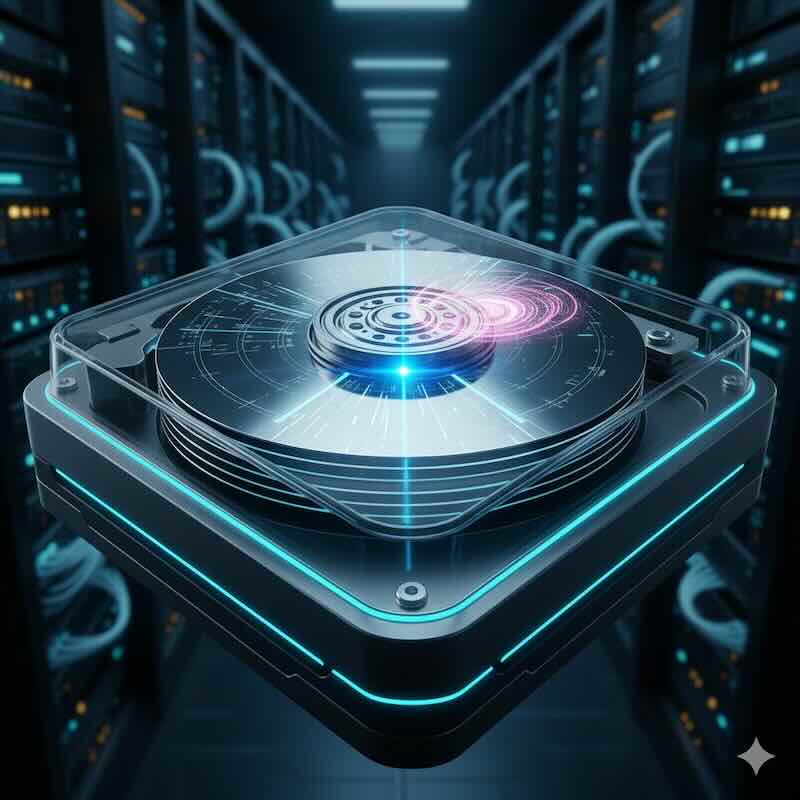
The Great Storage Showdown: HDDs Refuse to Die
In the world of storage, the narrative usually goes like this: Solid State Drives (SSDs) are the lightning-fast future, and Hard Disk Drives (HDDs) are the slow, whirring past. While SSDs have claimed victory in your laptop, the massive data centers running the cloud, Netflix, and every AI model you can imagine still need terabytes by the trainload, and SSDs just can't deliver that kind of bulk storage economically. The problem is that traditional hard drives hit a physical limit years ago called the "superparamagnetic limit." We literally couldn't cram any more data onto a platter without the tiny magnetic bits accidentally flipping—a real tragedy for your saved data. Now, engineers are getting creative, using tiny lasers and microwaves to break the laws of physics and usher in the era of the 100-terabyte drive!
The Nano-Laser Solution: HAMR and MAMR
The tech breakthrough that’s giving the old spinning disk a futuristic facelift is called HAMR (Heat-Assisted Magnetic Recording). In simple terms, HAMR uses a minuscule laser, integrated right into the read/write head, to briefly heat a specific spot on the magnetic platter as data is being written. This split-second blast of heat makes that tiny spot temporarily more receptive to magnetic change. Once the spot cools down (in less than a nanosecond!), the data is locked in place, allowing engineers to write smaller, denser, and more stable magnetic bits than ever before. This is the secret weapon allowing roadmaps to soar past current limits: 40TB drives are here now, and 60TB and even 100TB drives are planned before the decade is out. Its cousin, MAMR (Microwave-Assisted Magnetic Recording), uses a similar principle but with microwaves instead of heat—it's truly space-age stuff.
Impact: Fueling the AI and Cloud Revolution
These massive capacity jumps ensure the hard drive retains its critical role as the backbone of the entire digital universe. HAMR and MAMR are the keys to keeping the cost of data storage plummeting. This is vital for hyperscale data centers (Google, Amazon, etc.) which need to store petabytes of "cold" data—information that isn't accessed frequently, but must be archived. By enabling fewer physical drives to store the same amount of data, this technology dramatically improves power efficiency (fewer motors spinning!), reduces the physical footprint, and lowers the overall carbon cost of running the cloud. Essentially, HAMR keeps your streaming service affordable and gives those power-hungry AI models a place to park their ever-growing data sets.
The Trade-Off: Efficiency vs. Speed
While the capacity growth is fantastic, we need to take a cautious look at the trade-offs. The physics of a spinning disk haven't changed: the RPM (revolutions per minute) is largely the same, but the capacity has doubled. This means that while the drive's sequential read speed has gone up, the overall Input/Output Operations Per Second (IOPS) per terabyte has decreased. What does that mean for you? It confirms the storage hierarchy: the fastest, hottest data (like an operating system or a running application) belongs on a speedy SSD, while the cheapest, highest-capacity data (your massive video library or cold archives) will forever belong to the HDD. We also need to be mindful of reliability; the complexity of managing and rebuilding massive 60TB+ arrays means drive failure in the data center is a bigger, scarier problem than ever before.