High Tech vs. High Touch in a Digital Age: Why We Need to Touch the Grass
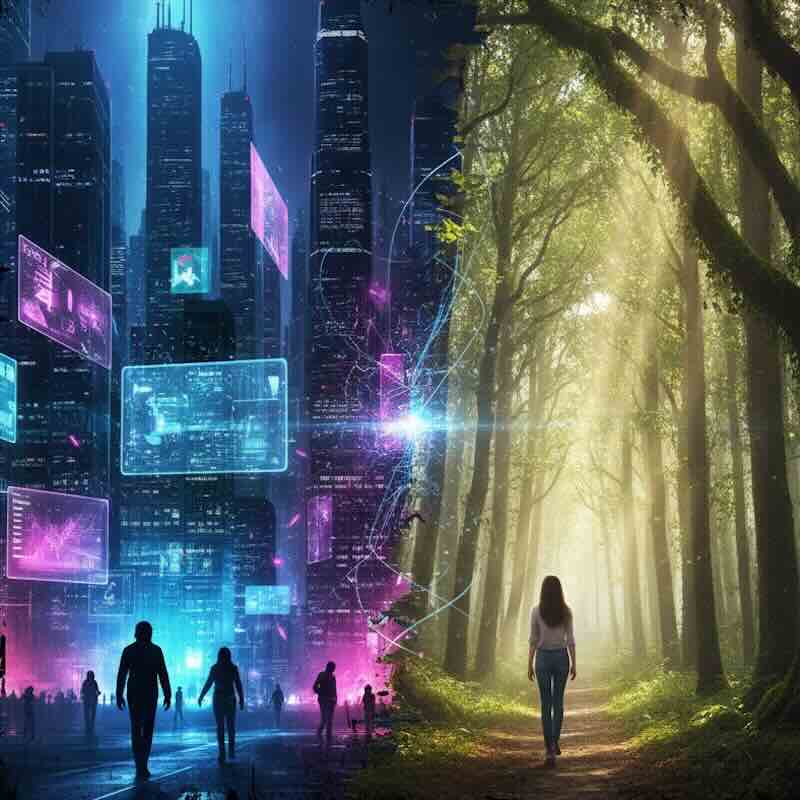
The Prophecy That Keeps Getting Truer
Back in 1982, when floppy disks were still cutting-edge and the internet was just a twinkle in a government lab's eye, futurist John Naisbitt dropped a bombshell of an idea in his book *Megatrends*: High Tech must be balanced with High Touch. The core concept was brilliant in its simplicity: The more technology we introduce into our lives (High Tech), the more we, as humans, will crave and need the counterbalance of genuine human interaction, sensory experience, and physical reality (High Touch).
At the time, "High Tech" meant things like personal computers and ATMs. Cute! Today, our "High Tech" is an omnipresent, AI-driven, augmented-reality metaverse that we carry in our pockets. We're talking about smart contacts that overlay digital data onto the real world, generative AI companions that write our emails, and entire workplaces existing in VR. If the High Tech of 1982 demanded a little "High Touch," the digital tidal wave we’re currently surfing requires an absolute tsunami of humanity just to keep our heads above water. The tension between the pixel and the physical is no longer a trend; it's the defining existential struggle of the modern era.
The Pervasive Pixel Problem: When Everything Becomes an Interface
Think about your average day. You wake up to a smart speaker, your job is on a screen, your social life is mediated by apps, your food is delivered via drone, and even your exercise tracker is a sophisticated data-harvesting machine. Our lives have become so digitally saturated that we are suffering from a condition I’m calling Pervasive Pixel Fatigue (PPF). We are cognitively exhausted from constantly processing feeds, notifications, and interfaces. Our brains, which evolved to spot predators and pick berries, are now spending eight hours a day managing email inboxes and avoiding deepfakes.
The "wow" factor of all this technology is undeniable. It's the ultimate convenience. I can video-conference with a colleague in Tokyo while getting my personalized medical diagnostics from a wearable sensor. That's *amazing*. But that very convenience has also carved out a deep, subtle hole in our collective psyche. High Tech is often designed to optimize efficiency; High Touch is about optimizing human connection and meaning. When you replace a trip to the bank with an ATM, you gain efficiency. When you replace a handwritten letter with a five-second emoji, you gain speed, but lose the irreplaceable warmth of ink on paper, the scent, and the effort that signals genuine care. The more frictionless life becomes, the more we realize that sometimes, a little *friction*—a human conversation, a physical trip, a real struggle—is what makes life feel *real*.
The Future Imperative: The Rise of the Authentic Experience
Naisbitt’s idea isn't just pertinent today; it's going to be the most critical social metric of the future. As Virtual Reality (VR) and Augmented Reality (AR) become indistinguishable from physical reality, the need for High Touch won't just be about comfort—it will be about sanity. When you can live a perfect, consequence-free life in a personalized metaverse, the value of the imperfect, messy, physical world will skyrocket.
We are already seeing this trend explode in the marketplace: the rise of artisanal everything, the demand for "farm-to-table" food, the obsession with vintage vinyl records, and the explosion of outdoor adventure tourism. These are all market-driven High Touch counter-reactions to an increasingly digitized world. People are willing to pay a premium for things that involve real, sensory, human-centered processes. The future of luxury isn't owning the newest gadget; it's owning the time, space, and ability to unplug and experience something physical and authentic.
The Dark Side: Emotional Erosion and Social Fragmentation
But let's hit the brakes and look at the practical, cautionary side. The lack of High Touch isn't just making us nostalgic; it's actively harmful to the human psyche and social structure. Psychologically, substituting complex human interaction with filtered, mediated screens leads to increased feelings of loneliness, social anxiety, and digital depression. Our brains are not getting the complex feedback loops—the micro-expressions, the tone, the body language—that are essential for emotional regulation and empathy. We are replacing connection with mere communication.
On a social level, the digital echo chamber—the high-tech personalization that only shows us what we already believe—is leading to massive social fragmentation. We are losing the shared, physical civic spaces (the town square, the common park bench) where we are forced to rub shoulders, sometimes uncomfortably, with people who are different from us. High Touch is, fundamentally, a communal experience; High Tech can easily be a solitary, isolating one, leading to the tribalism and lack of nuanced understanding that plagues modern discourse. The less we have to deal with real, physical people, the easier it is to demonize them online.
The Call to Action: Go Touch the Grass (Seriously)
So, what's the techno-solution? Ironically, the solution is non-technological. It is a conscious, intentional choice to prioritize High Touch. It means designing technology with "exit ramps" built in—interfaces that remind you to look away, collaborative tools that encourage in-person meetings, and systems that value local, physical community.
For us, the users, it means embracing the radical act of touching the grass. This is the ultimate symbol for reconnecting with the physical, non-digital world. It’s a metaphor for taking a walk in the woods, planting a garden, having an unmediated, face-to-face conversation with a friend, or simply sitting in silence without a glowing screen in your hand. The environmental impact of High Tech (e-waste, data center energy use) can only be truly appreciated if we take the time to step away and appreciate the non-synthetic world we are supposedly building all this tech to protect.
The core lesson of High Tech/High Touch remains our guiding star: Technology is a marvelous servant, but a terrible master. As the world races toward the metaverse, the true wealth will be found in the mundane, physical reality it tries to replicate. Our humanity is our greatest software, and it requires regular maintenance in the form of sunlight, soil, and genuine human connection. Now, if you'll excuse me, I’m unplugging my router and going to smell some actual roses.