Mad Max Futures: Are We Lurching Towards a Low-Tech, High Mohawk World?
The Revolution Nobody Saw Coming
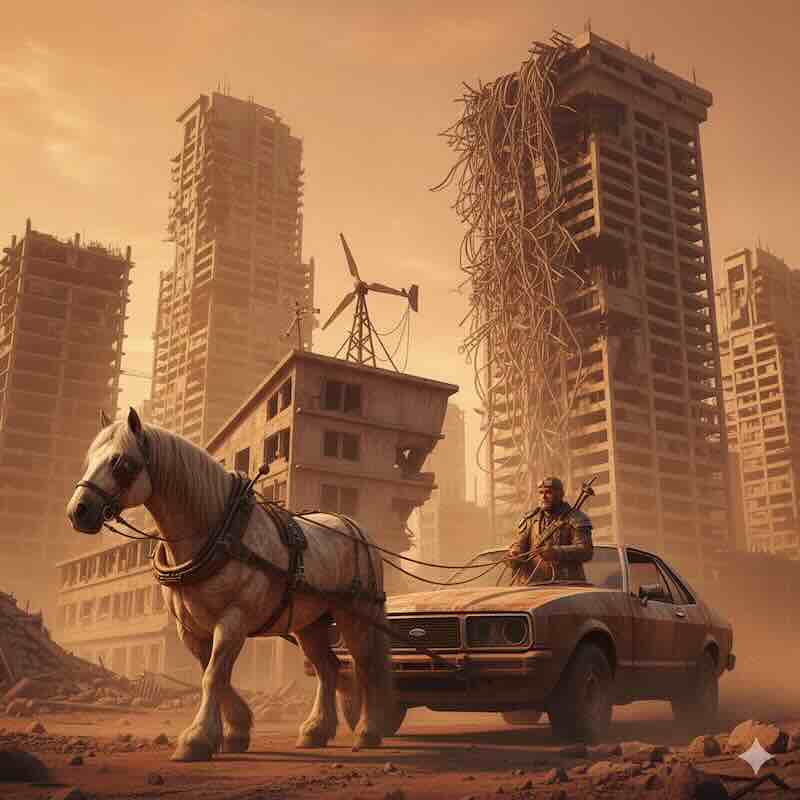
The 1980s were a a decade where cinema loved to portray "Mad Max" futures where society has crumbled due to war or other causes, and technology has been turned on its head. Odd scenes showed crumbling automobiles being pulled by horses, and other remnants of modern technology being used side by side with much more ancient contraptions, as the people who remain alive struggle to keep going in a feudal, post-apocalyptic world populated by folks with colorful 80s Mohawk hairdos.
How far fetched is all that? Could we be marching toward a similar destiny, and if so, what shape might it take?
🤯 The Beauty of Brittle Technology
The **Wow Factor** here is a dark one: the staggering complexity of our current infrastructure. Think about your smartphone. It’s a magic glass rectangle that grants you access to all of humanity’s knowledge. But how much *stuff* has to work perfectly for it to function? A global network of fiber optic cables, GPS satellites, power grids that rely on thousands of inter-dependent components, rare earth mineral mines in distant countries, and a global logistics chain to deliver the next charging cable. It's a miracle, but it's also terrifyingly fragile.
The genius of a **horse and carriage**, in contrast, is its self-sufficiency. You need oats, a horseshoe, and a little leather repair skill. The genius of a modern car is the speed it provides, but its fragility is its fatal flaw. One bad EMP, one massive solar flare, or just one sustained global recession that starves the supply chain of microchips, and your Tesla instantly becomes a very heavy, very expensive lawn ornament. Suddenly, the horse looks like the cutting edge of reliable transportation. **This is the 'Mad Max' genius: reversion to resilient, repairable, low-tech solutions.**
💣 The 'Soft Max' Scenario: Erosion, Not Explosion
Forget the nuclear bombs. The most likely path to a low-tech future isn't a single, spectacular event, but a slow, systemic failure—what we at TechnoBLOG are calling the **'Soft Max'** scenario. It’s not about war; it’s about complexity, cost, and climate change.
Imagine a series of escalating, interconnected crises:
- **Global Supply Chain Calcification:** Geopolitical conflicts and climate-induced disruptions (droughts, floods) permanently snarl the flow of key components, especially microchips. Manufacturing stalls.
- **The End of Software Updates:** The companies that make your smart fridge, solar panel controllers, and even your car software go bankrupt or stop supporting older models. The software dies, and the hardware becomes a useless brick—a process known as 'planned obsolescence' on steroids.
- **Grid Fluctuation:** Extreme weather events (super-storms, heat domes) become so frequent that maintaining the centralized power grid becomes impossibly expensive and logistically nightmarish. Power becomes intermittent, localized, and unreliable.
In this 'Soft Max' world, no one is fighting over gasoline; they are fighting over old, working copper wire and repair manuals for 1970s diesel engines. The tech doesn't disappear; it just becomes **obsolete and unfixable** for a population that has lost the knowledge of how to make things without a 5-axis CNC machine. Your 80-inch smart TV becomes a nice, flat piece of window-replacement glass. is a good way to visualize this kind of systemic stress.
🏡 The Practical Reversion: From Smart Home to Stone Hearth
So, what does practical life look like? It's a world defined by self-reliance and localism. The complex, automated systems that required global support are abandoned for simple, robust alternatives. * **Communication:** Satellite internet is out, but local, hand-cranked amateur radio (Ham radio) networks are thriving. The internet has been replaced by community-maintained mesh networks powered by repurposed batteries. * **Power:** Massive power plants are derelict. Communities rely on local power generation: micro-hydro, small solar setups (the simpler, older panels that are easier to fix), and biomass/wood gas generators. * **Transportation:** Cars that don't need complex computers—like old pickup trucks or pre-1990s diesels—become invaluable. For short distances, we revert to bicycles, animals, and good old-fashioned walking. This is where the horse pulling the car becomes less a joke and more an act of resourcefulness: using the chassis of a car as a very durable wagon. * **Agriculture:** We shift from centralized, computerized mono-crop farming (which requires precise fertilizer inputs and massive machinery) to **local, resilient, bio-intensive farming**—the kind your great-grandparents did. Local knowledge becomes the most valuable commodity.
🧠 The Psychological and Social Trade-Offs
This is where the TechnoBLOG realism kicks in. A low-tech future is not a romantic return to nature; it's a brutal trade-off. **The social implications are profound:**
👉 **The Loss of Universal Knowledge:** The collective, hyper-accessible knowledge of the internet vanishes or becomes fractured. Progress slows to a crawl because information must be manually copied, stored, and transported. The average person's understanding of the world shrinks back to their local community. The rise of new, localized 'feudal' power structures based on who controls a working generator or the last known copy of a repair manual is a serious risk. Social division could intensify.
👉 **The Mental Load:** For a hundred years, we’ve outsourced survival to technology. In a 'Soft Max' world, that mental load snaps back. Everything takes more time, more energy, and more physical effort. The stress of constant resource management (water, power, food security) would take a massive toll on the human psyche, leading to higher rates of anxiety, depression, and localized conflict. **Creativity would shift from abstract thought (AI art) to applied survival (how to make soap from ash).**
👉 **The Unexpected Environmental Plus:** The one true benefit is environmental. A large-scale collapse of the global supply chain, industrial manufacturing, and global transport would dramatically cut carbon emissions, pollution, and the demand for resource-intensive electronics. The Earth would get a long, painful, but much-needed break. The environment, having suffered under high-tech, begins to heal under low-tech, localized human impact.
🔮 The TechnoBLOG Verdict: Build Redundancy, Not Just Flash
So, should we all start practicing welding and growing potatoes? Maybe. But the real takeaway isn't that technology is bad; it's that **fragile, highly centralized technology is a systemic risk.**
The future we *should* be building is one of **Resilient Tech**—systems that are local, repairable, open-source, and can operate independently. We need to invest in localized, off-grid power (like small modular nuclear or community solar grids), robust mesh communication protocols, and manufacturing techniques that use common, easily sourced materials. We should learn to build not just complexity, but **redundancy.**
The 'Mad Max' vision serves as an excellent warning: technology is only as strong as its weakest link. And right now, our global, interconnected chain is looking awfully brittle. Let's make sure our future looks less like a horse pulling a junk car, and more like a network of robust, local, tech-savvy communities that don't panic when the WiFi goes down. **The next great technological leap might not be complexity, but simplicity and resilience.**