The Future of Music: AI Composers, Brain Interfaces, and the Battle for the Human Soul
When Your Playlist Writes Itself
Let's get straight to the mind-bending part: we're approaching a future where music doesn't just respond to your mood—it reads it directly from your brain and composes itself in real-time. AI music generators like Suno, Udio, and others are already creating surprisingly decent tracks from text prompts. Meanwhile, companies are developing neural interfaces that can detect emotional states with increasing accuracy. Put these two trajectories together, and you get something wild: music that literally couldn't exist without you, created on the fly based on your neural activity, stress levels, and subconscious preferences.
Imagine going for a run, and instead of shuffling through pre-made playlists, an AI composer generates a progressive house track that evolves with your heart rate, building to crescendos as you push harder, easing into ambient textures as you cool down. Or picture a meditation session where the soundscape shifts in response to your brainwaves, helping guide you deeper into relaxation. It sounds like science fiction, but the building blocks are already here.
The Democratization Dilemma
Here's where it gets complicated. On one hand, AI music tools are incredibly democratizing. You don't need years of music theory, expensive instruments, or studio access to create something that sounds polished. A kid in rural Wisconsin can now generate a full orchestral score or a trap beat with production quality that would've required tens of thousands of dollars in equipment just a decade ago. That's genuinely amazing.
But—and this is a big but—there's a real risk of flooding. When everyone can generate music effortlessly, what happens to the signal-to-noise ratio? Streaming platforms are already struggling with millions of tracks uploaded monthly, most of which get virtually zero plays. Add AI-generated music to the mix, and we could see an explosion of content that makes discovery nearly impossible. The human artists who spend years honing their craft might find themselves drowned out by an endless tsunami of algorithmically-generated "good enough" music.
Spatial Audio and the Concert Hall of Your Mind
Let's talk about something already transforming how we listen: spatial audio. Apple's pushing it hard with their AirPods and Vision Pro, and it's not just marketing hype. When done right, spatial audio creates a three-dimensional soundstage that can place instruments and voices in specific locations around you. Imagine listening to a jazz quartet where you can "walk around" the virtual stage, getting closer to the upright bass or positioning yourself right next to the drummer.
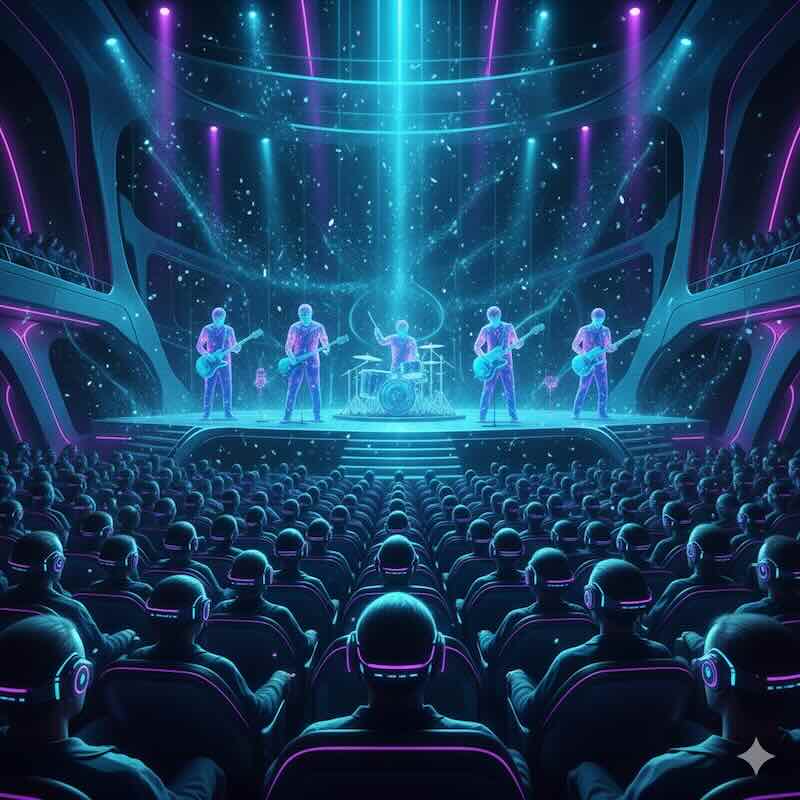
Future concerts might not require you to leave your living room at all. Artists could perform in virtual spaces with photorealistic avatars, while you experience it through a headset with haptic feedback that lets you feel the bass in your chest. We're talking about performances that could happen on the surface of Mars, inside a nebula, or in impossible architectural spaces that defy physics. And unlike traditional concerts, these could be perfectly mixed for your specific position, with audio that adapts to where you're looking.
The Authenticity Question
Here's where my inner skeptic kicks in. Music has always been deeply human—a form of expression that channels emotion, struggle, joy, and pain through sound. When an AI generates a sad song, is it actually sad? Can an algorithm understand heartbreak? These might sound like philosophical questions, but they matter. Part of what makes music powerful is knowing that another human being felt something and managed to translate that feeling into sound waves that trigger similar emotions in us. That's connection. That's empathy in action.
If we move toward a future dominated by AI-generated music, we risk losing that human thread. Sure, the music might sound pleasant, might even be optimized to trigger dopamine release in our brains, but will it have soul? Will it challenge us, surprise us, make us feel understood? Or will it just be sonic comfort food, endlessly recycling patterns that algorithms know we like?
The Environmental and Economic Angles
On the practical side, there are real-world implications. AI music generation requires significant computational power, which means energy consumption. As these systems become more sophisticated and widespread, we need to consider the carbon footprint of generating billions of personalized tracks. It's not zero.
Economically, we're heading into uncharted territory. How do you compensate artists when AI has been trained on their work? The legal battles are already starting. And what happens to session musicians, producers, and sound engineers when AI can handle their roles? We might be looking at a future where only the absolute top-tier human performers can make a living, while everyone else is undercut by free or nearly-free AI alternatives.
Finding the Balance
So where does this leave us? I don't think the future of music is all-AI or all-human—it's probably going to be a messy, complicated hybrid. The best outcome might be treating AI as a powerful tool rather than a replacement. Imagine human composers using AI to explore harmonic possibilities they'd never considered, or producers using neural interfaces to capture the exact emotional texture they're trying to convey, then crafting it with human intentionality.
The technology is coming whether we're ready or not. What matters is how we choose to use it. Do we let it flatten music into algorithmically-optimized background noise, or do we use it to expand what's possible while keeping human creativity at the center? That choice is still ours to make—at least for now.
The future of music is going to be strange, spectacular, and probably a little scary. But if we're thoughtful about it, it might also be the most creative era in human history. We just need to make sure we don't lose the human heartbeat in all the digital noise.