When 'Old Tech' Becomes 'High Touch': The Joy of Friction and the Vinyl Revival
WHEN "OLD TECH" BECOMES "HIGH TOUCH"
As I wrote about in a previous TechnoBLOG article, our ever-increasing immersion in high tech increases conveniences and can, in some ways, enhance the life experience, but decades of research have shown the need for us to balance tech with touch. "Feel the Grass" has become a recent rallying cry that emphasizes that same idea.
But do our escape-the-tech trap doors all need to take the form of tree-hugging? Maybe not. I recently purchased a 1915 Victrola record player that was the technical rage at that time. It involved remarkable new developments that allowed sound to be mechanically transferred to a disk, and then played back. It was the stuff of goosebumps at the start of the 20th Century. Now, it's as quaint as a butter churn, and I get great pleasure out of playing also-ancient 78 RPM discs on it.
Even newer turntables are seen as pretty low tech compared to CDs read with lasers, or computers that can store thousands of songs in an area the size of the head of a pin. Yet a growing number of people, even young people in their teens and 20s, are embracing vinyl as a stylish trend and a calming return to a simpler time.
The Magic of the Physical Process
This is where the High Tech/High Touch paradox gets really interesting. My Victrola isn't just an antique; it’s a portal to a time when technology demanded intentionality. Streaming music is immediate, infinite, and invisible—it’s the ultimate convenience. But vinyl demands a ritual. You must *select* a record, pull it from its sleeve, carefully place it on the platter, lower the tonearm, and then sit there, committed, for about 20 minutes until you flip it over. This friction—this mandatory physical process—is precisely what delivers the "High Touch." It engages all your senses: the smell of the vinyl, the warmth of the album art, the tiny *pop* before the music starts, and the committed act of listening without skipping tracks.
The Vinyl Revival isn't just about sound quality (though many purists will argue it’s superior). It’s about forced mindfulness. When you have to stand up, walk across the room, and manually flip the record, you are breaking the cycle of passive consumption. In a world where Netflix asks, "Are you still watching?" every two hours, the Victrola politely, firmly, insists: "Pay attention." That’s a powerful, anti-digital antidote.
The Return of the Hand-Cranked Future
This same craving for friction and physicality is popping up across multiple domains, turning yesterday’s cutting-edge into today’s cherished quaintness. Let’s look at a couple of other "old tech" favorites that are seeing a glorious High Touch revival:
Film Photography: The Anti-Instant gratification
Digital cameras and smartphones have turned everyone into a trigger-happy photographer, creating billions of images that exist only as ephemeral, pixelated noise on a cloud server. Contrast this with the growing, vibrant communities centered around film photography. Why would a young person choose a bulky, manual film camera from the 1980s that only holds 36 shots?
Because film enforces scarcity and commitment. You can't review the shot immediately. You have to wait, sometimes for days or weeks, to develop the film. This forces a photographer to be incredibly judicious, to truly *think* about composition, light, and moment. The image becomes a precious artifact born of patience and effort. The chemical process of developing the film—smelling the fixer, watching the image magically appear in the tray—is the ultimate High Touch experience. It’s messy, it's slow, and the resulting print is a unique, tactile object that holds undeniable emotional weight. It's the difference between sending a thousand texts and sending one hand-sealed letter.
Manual Typewriters: The Art of the Permanent Word
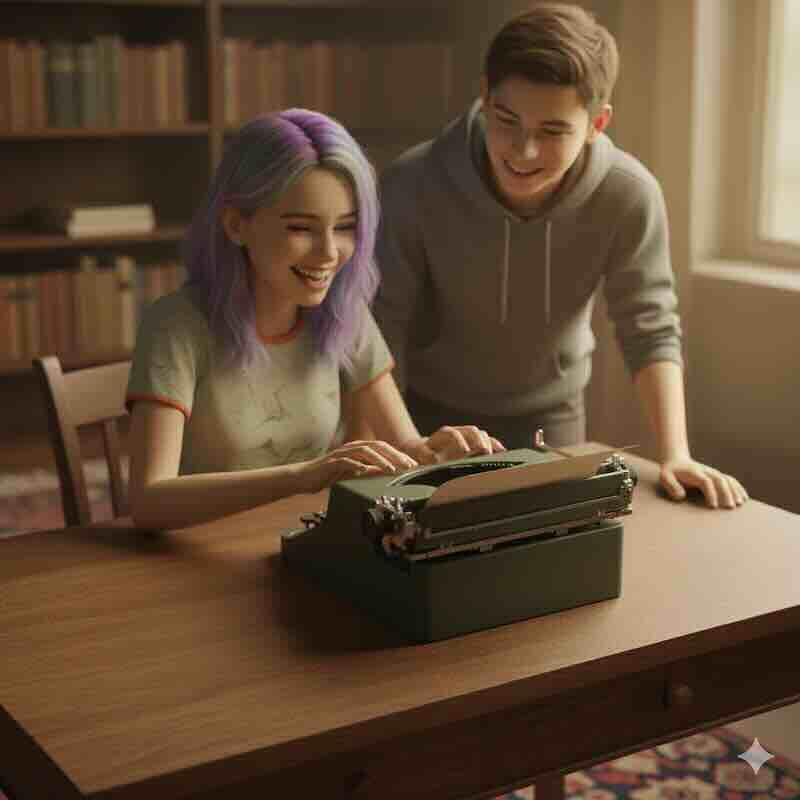
For decades, the word processor has been hailed as the peak of efficiency. Instant corrections, infinite deletions, and perfect formatting. Yet, visit any trendy coffee shop or independent bookstore, and you might spot someone clanking away on a refurbished manual typewriter. Why subject yourself to the tyranny of a carriage return and the impossibility of the backspace key?
A typewriter removes the digital safety net. When you strike a key, the letter is committed to the page. *Permanently.* This process encourages a flow state, forces you to structure your thoughts before you strike the key, and rewards clear, focused writing. The sound—that rhythmic *clack-clack-clack* followed by the satisfying *ding!* of the carriage return—is a sonic signature of productivity. The final result is a physical document with texture and ink bleed, a piece of tangible art that carries the authentic marks of the writing process, including the mistakes. The act of creation becomes a physical collaboration between the mind, the fingers, and the machine's beautiful mechanics.
The Environmental and Social Benefits of Slow Tech
Looking at "Old Tech" through a modern lens reveals practical benefits that contemporary high tech often lacks:
* Environmental Sustainability (The Low-Power Factor): A Victrola or a manual typewriter requires zero electricity. Even a 35mm camera, barring the small battery for a light meter, is completely self-sufficient. This low-power consumption is an enormous High Touch benefit, reducing our dependency on the massive, resource-draining digital infrastructure we critiqued in the last article. * The Power of Repair: Old tech is often mechanically transparent and repairable. Your Victrola can likely be fixed with a few tools and a little mechanical know-how. Contrast that with modern electronics, which are designed with proprietary screws and glued-shut compartments that make repair nearly impossible. The ability to understand and fix our tools is a deeply satisfying high touch skill that combats our increasing helplessness in the face of complex, black-box digital systems.
Intentionality as the New Frontier
The irony is that these pieces of "Old Tech" are no longer just devices; they have been spiritually promoted to tools for living intentionally. They are a conscious resistance against the digital trend of infinite choice, speed, and invisibility. They celebrate limitation, permanence, and physical engagement.
As we continue to build our dazzling, futuristic, High-Tech world of AI, VR, and self-driving everything, the need for high touch will only grow more acute. But we don't always need to run barefoot in the grass to find that balance. Sometimes, the most meaningful form of "touching the grass" is simply taking the time to wind up a 1915 phonograph, listen to a scratchy song, and connect with a piece of beautiful, mechanical history. The future, it turns out, is still being built with a loving appreciation for the past.