POTTY TRAINING: Why "What Goes Down the Drain" is Helping Train Ai Brains
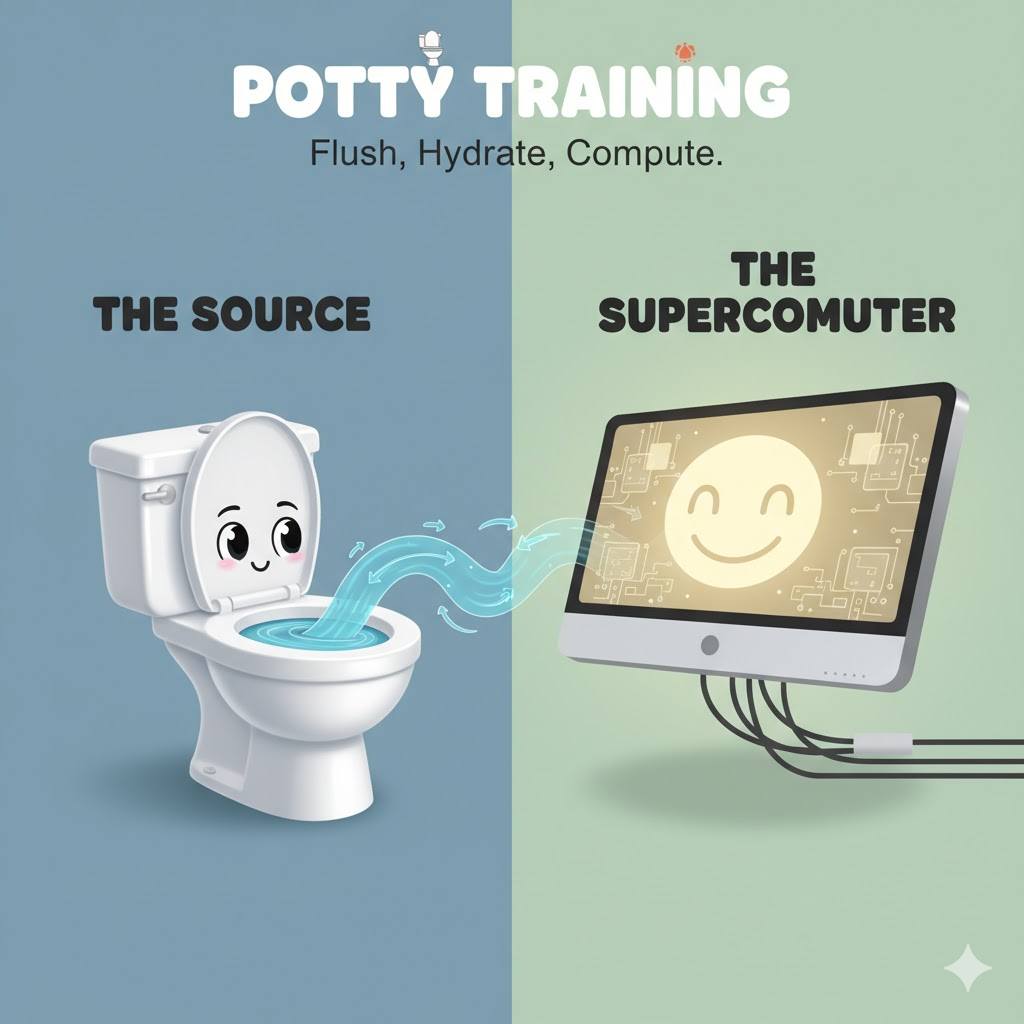
How Your Toilet is Helping Solve Some of Life's Most Difficult Questions
Forget gold and oil—the resource that AI mega-data centers are clamoring for is the stuff you flush away. That’s right, the very essence of human life (and last night’s questionable chili) is being reclaimed, purified, and piped directly into the temples of Artificial Intelligence.
AI data centers use massive amounts of electricity, especially during "training runs," when they are forced to work overtime to learn new stuff (a process that can take months and burn through staggering amounts of power...measured in tens or even hundreds of gigawatts).
Those whirring servers generate intense heat, and the cheapest, most efficient way to cool them is through evaporation, which constantly requires new water—gallons of it, every minute. A typical data center can rival the daily water consumption of a medium-sized town. Using clean, drinking-quality (potable) water for cooling naturally draws the rancor of local communities facing drought, since water evaporated is water lost to the atmosphere.
Enter the humble wastewater treatment plant. Why? Because data center operators have come to realize that, for their needs, clean water isn't necessary; clean-enough water is. Instead of fighting for precious drinking water, data centers are partnering with municipal utilities to take their effluent—the treated sewage that would otherwise flow back to a river or lake.
How Our "Relief" Becomes Their "Relief"
- The Flush: You do your part (we won't get graphic).
- The Treatment: The municipal plant performs primary and secondary cleaning, but most importantly, a tertiary polish.
- The Pipeline: The water, now purified to an industrial standard (clean enough to avoid damaging multi-million dollar machinery), is delivered straight to the data center’s cooling towers.
- The Payoff: The water is turned into steam to cool the supercomputers that are crunching data, training algorithms, and, perhaps, analyzing what you’re currently browsing.
It’s the ultimate circular economy: what you use for a moment of relief is then put back to work to power the AI that drives technology's future. Is there a downside? Well, to be efficient, an AI data center taking advantage of your "byproducts" should ideally be placed as near a wastewater treatment plant as possible. That means the employees at the data center might prefer arriving at work on the days when their facility is upwind of its coolant source. So, the next time your AI chatbot gives you a particularly brilliant answer, just remember to thank your nearest sanitation engineer. They are the unsung heroes powering the silicon future, one flush at a time.