The Concrete That Doesn't Crack: Building the Immortal Infrastructure
A Silent Revolution Beneath Our Cities
Cracked foundations, crumbling bridges, and endless road repairs—these are the visible costs of time and stress on our concrete infrastructure. Concrete, the world’s most used material after water, is fundamentally fragile, constantly degrading and requiring massive public funds for maintenance. But engineers are on the verge of turning this weakness into a spectacular strength with self-healing concrete, a material designed to repair its own damage.
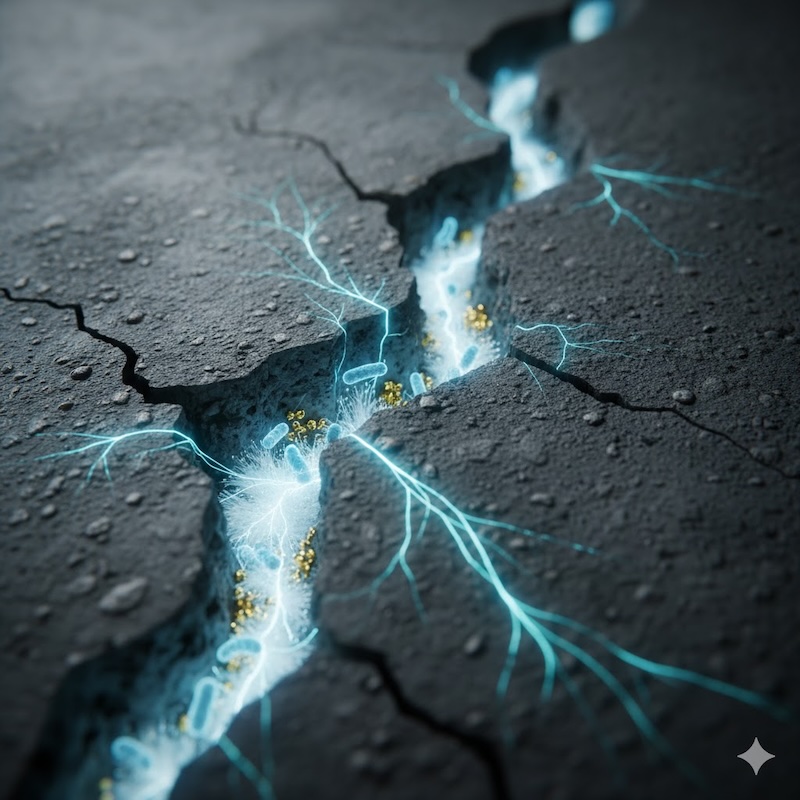
This isn't science fiction; it's microbiology. The most promising technique involves mixing dormant, non-toxic bacteria and their food source (calcium lactate) into the fresh concrete. When a micro-crack appears, water seeps in, waking the bacteria. These tiny, living engineers consume the food and excrete calcite (limestone), which is solid, insoluble, and perfectly fills the crack, sealing it off permanently. This process can repair cracks, effectively giving structures a self-perpetuating immune system.
The Promise: Beyond Maintenance
Imagine a world where the multi-trillion-dollar annual cost of infrastructure repair is drastically reduced. Bridges could last hundreds of years longer. Nuclear waste storage bunkers could seal themselves against leakage. Seawalls and harbor structures, constantly battered by saltwater, could become immune to corrosion. This technology offers the potential for immortal infrastructure, freeing up resources, reducing landfill waste from demolition, and dramatically cutting down the energy footprint associated with producing new concrete. A little fun fact about this track: The bacteria often used, like Bacillus subtilis, are common soil bacteria that pose no threat to humans.The clear benefit is resilience: making critical structures more durable against extreme weather, earthquakes, and simple wear-and-tear. It’s a leap forward into a sustainable future where our foundational materials work with us, adapting and rebuilding on their own.
The Cautionary Mix: Cost, Scale, and Control
While the awe factor is high, the challenges are equally concrete. Cost remains the primary hurdle; adding bacterial spores and nutrients significantly increases the initial price tag compared to traditional concrete. Scaling up production to meet global demand requires immense investment and standardization. Furthermore, the performance of the bacteria can be unpredictable depending on the specific environment, temperature, and depth of the crack. Did you know the lifespan of the spores within the concrete must be long enough to survive for decades until a crack occurs?
A deeper concern lies in the potential for unintended consequences. We are introducing living organisms into the foundational fabric of our cities. While the current bacteria are harmless, the reliance on a biological mechanism raises questions about potential evolutionary risks or vulnerability to extreme conditions that could render the healing process inert. As we embrace this self-repairing world, we must ensure rigorous testing and strict control over the biological agents to prevent future architectural—or ecological—unraveling.