Floating Vertiports: Why Air Taxis Are Targeting Water for Their Landing Pads
Solving the Urban Air Mobility Bottleneck with Blue Infrastructure
The dawn of Electric Vertical Take-off and Landing (eVTOL) air taxis promises to revolutionize urban commuting, turning hour-long commutes into rapid, minutes-long flights. Yet, this high-tech vision runs into a low-tech problem: where do they land? Densely populated cities lack available real estate for new conventional vertiports, creating an infrastructure bottleneck that threatens the entire Advanced Air Mobility (AAM) industry. The solution? Floating vertiports.
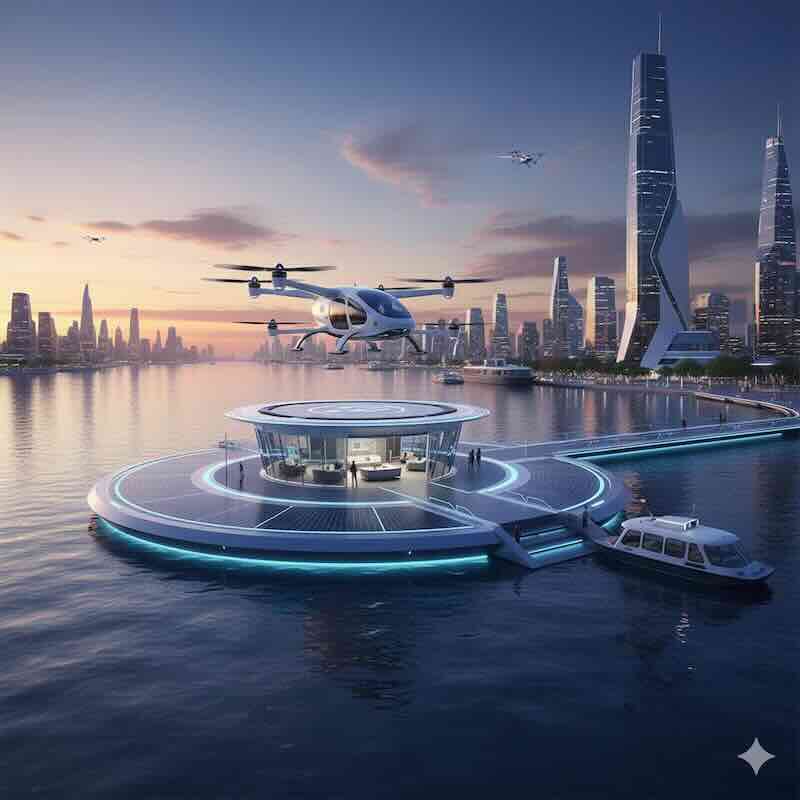
By leveraging underutilized urban waterways, coastal zones, and lakes, developers can rapidly deploy zero-carbon landing platforms without requiring complex or time-consuming land development. These water-based hubs are essentially mobile, self-propelled barges equipped with landing decks, integrated photovoltaic charging, energy storage, and dispatch centers. This mobility allows operators to reposition landing sites based on peak demand or specific events, providing unparalleled flexibility in city-to-city, coastal, and inter-island transport scenarios. For instance, a vertiport positioned on a major river in a coastal city can enable rapid transit between a downtown business district and a far-off airport, a journey that might otherwise involve hours of road traffic.
The Final Descent: Passenger Transfer and Last-Mile Logistics
Once an air taxi lands safely on a floating vertiport, the focus immediately shifts to getting the passengers to their final destination on land. The vertiport is designed with a cabin area that functions as a small departure lounge and technical room for charging and data coordination. Because these platforms are mobile and often temporary, they are typically deployed close to existing transportation networks to solve the "last mile" problem.
Passenger transfer is primarily handled via two main methods. First, for platforms situated near a waterfront, a simple, covered gangway or retractable bridge is deployed to connect the floating deck directly to an existing pier, wharf, or shoreline promenade. This allows passengers to disembark quickly and walk directly onto shore. Second, for vertiports anchored slightly further offshore or those acting as mobile clusters, the transfer relies on high-speed, electric feeder vessels (water taxis). These dedicated boats shuttle passengers the short distance from the floating vertiport to a fixed, permanent terminal on land. This segregated transfer ensures quick turnaround times for the air taxi itself, allowing it to recharge and take off again with minimal delay, maximizing the efficiency of the overall network. This integration of air, sea, and land transport provides a cohesive, seamless journey for the high-frequency commuter.